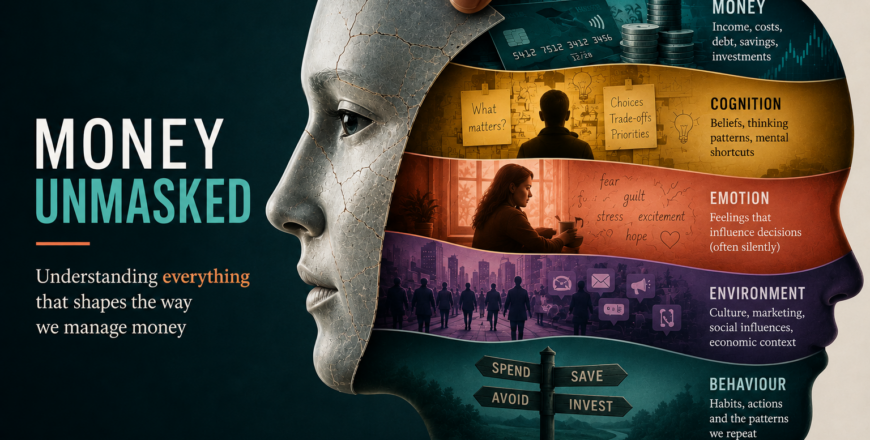
Money Unmasked


- Description
- Curriculum
- Reviews
Money Unmasked
The Science of Financial Behaviour for the Neurodivergent Brain
Money Unmasked is a research-informed financial wellbeing programme designed to help neurodivergent adults understand their financial behaviour and build a financial system that works with the way their brain operates.
Taught by Jouré Rustemeyer and Dr. Julia Myers, founder of Generational Wisdom®, the course brings together neuroscience, psychology, financial behaviour, wealth-building and practical financial planning.
Across 11 modules, you’ll explore spending, executive function, money beliefs, debt, budgeting, earning, investing, relationships, wealth and legacy—before bringing everything together into your own Personal Financial Blueprint.
Understand your financial behaviour. Build a financial system that works for you.

-
2
 Objective
hjhh
-
3
Part 1 — Why Knowing Isn't Enough
Before we can change the way we manage money, we need to understand what actually shapes our financial behaviour. This module looks beyond budgeting and financial knowledge to explore the interaction between money, cognition, emotion, motivation, behaviour and the environment around us. It examines executive functioning, reward and decision-making, stress, emotional regulation, neurodivergence and the financial systems we operate within. Most importantly, it introduces a different way of looking at financial difficulties: not as personal failure, but as the result of an interaction between the person, the task and the environment.
-
4
Part 2 - What Gets In The Way?
Part 2 explores what can get in the way of effective financial behaviour. It looks at the interaction between stress, emotional regulation, reward, motivation, avoidance, neurodevelopment and the environment around us, and examines why knowing what to do does not always translate into action. Most importantly, it builds on the person, task and environment framework to show how financial difficulties can arise from different underlying factors — and why the most effective solutions need to address what is actually getting in the way.
-
5
Bonus - Between Knowing and Doing: Your Module 1 Toolkit
Knowing what to do with money isn’t the same as being able to do it consistently. These worksheets help you find out what sits in between for you: the strengths you already have, the parts of managing money that ask the most of you, and what a behaviour might be doing for you. They are a starting point for asking “What is making this difficult for me?” instead of “Why am I bad with money?”
-
6
 Module 1 - Knowledge CheckTen questions to check your understanding of the key ideas in Module 1: what financial literacy includes, how executive functions and reward affect money, why avoidance keeps happening, and why the same money problem can have different causes. It isn't a test of how good you are with money. The answers, with explanations, are on the last page.
-
7
Part 1 - Start With Your Roots
We all carry beliefs about money that we didn't choose. In this part, we look at where your money story comes from: the four influences that shaped it, the messages you heard versus the ones you absorbed by watching, and how "I'm bad with money" can turn everyday struggles into shame.
-
8
Part 2 - Rewriting The Story
Understanding your money story is the first step. Changing it is the next. In this part, we separate net worth from self-worth, look at scarcity and what "enough" means, and sort what you were handed into what you want to keep, change, stop and start. Then you'll turn one old belief into one small, practical change.
-
9
Bonus - Unpacking the Backpack: Your Module 2 Toolkit
Most of the beliefs we carry about money were packed for us long before we had any say. These exercises help you open the backpack, see where your money beliefs came from, and decide what stays and what goes. Your money story can be your limit or your leverage. These tools help you choose which.
-
10
Module 2 - Knowledge Check
-
11
Part 1 - What Happens Before a Purchase
Before we can change our spending, we need to understand what happens between noticing something and paying for it. This part explores impulse buying, reward and anticipation, attention, novelty, hyperfocus, emotional states, tiredness and the influence of the consumer environment.
-
12
Part 2 - What Captures Attention
Examine how attention, novelty and hyperfocus can shape spending, and why different patterns of intense interest or browsing may require different strategies.
-
13
Part 3 - The State I Am In
Look at how emotional states, stress, tiredness and cognitive load can influence the conditions under which spending decisions are made.
-
14
Part 4 - Waiting
Explore delayed gratification, the value of creating a pause before purchasing, and ways of making future financial benefits more concrete.
-
15
Part 5 - Changing the Pattern
Move from understanding spending behaviour to changing it through identifying personal triggers, creating healthier reward systems and using advance planning strategies such as if–then plans.
-
16
Bonus — Space Between the Urge and the Purchase: Your Module 3 Toolkit
The aim isn’t to stop wanting things. It’s to create enough space between the urge and the purchase to make a deliberate decision. These worksheets help you track what sets your spending off, work out what your spending gives you, and use practical tools at each stage of the purchase process, from the first trigger to the moment you pay.
-
17
Module 3: Knowledge Check
-
18
Part 1 - The Hidden Work In Money Tasks
Even simple money tasks, like checking a bank account or paying a bill, are made up of several smaller steps. Each step relies on a different mental skill: planning, organising, remembering to act at the right time, and keeping track of time.
In this part, we break money tasks down to see what they actually ask of us. We look at why intentions often don't turn into action, and why "just remember to do it" so often doesn't work.
-
19
Part 2 - Getting Unstuck
Sometimes we know exactly what needs doing and still put it off. In this part, we look at why money tasks get stuck: avoidance, paperwork, and the mental load of too many decisions or tasks that are too big.
You'll learn to work out what exactly you're avoiding, and to reduce the number of decisions and the size of each task, so that starting asks less of you. We finish by looking at what this means for building a money system that works for you, which is where Module 5 picks up.
-
20
Bonus — Making Money Tasks Ask Less: Your Module 4 Toolkit
A money task that looks simple often hides a lot of work: planning, remembering, starting, deciding and checking. These worksheets help you see that hidden work, find where your tasks get stuck, and make them ask less of you. The aim isn’t to get better at every executive function. It’s to change the task so it fits the way your brain works.
-
21
Module 4 - Knowledge Check
-
22
Part 1 - Building The System
Instead of relying on yourself to remember and act at exactly the right moment, you can set things up so your money system does some of the work. In this part, we look at the four pillars of a brain-friendly system: automation, how your bank accounts are set up, reminders that arrive when you can act on them, and routines you can turn into habits by linking them to events that already happen.
-
23
Part 2 - Making It Work For You
A system only helps if it fits the person using it. In this part, you'll use if–then plans to keep the system running, adapt it to the way your brain works, and build your own system. Then you'll set up a review loop so the system changes as your life does, and see how the same approach can work for a business.
-
24
Bonus — Practical Tools for Building a System That Works for You
A set of worksheets to help you turn this module into a working money system. Use them to sort what needs automating, a reminder or a routine, set up and name your accounts by purpose, save for goals that feel far away, build cue-based habits, keep track of yearly deadlines, and apply the same system to your business.
-
25
Part 1 - How Much Goes Where?
Find out what your money actually needs to cover and how much might reasonably go where. This part covers take-home income (including what it means if you run your own business), starting guidelines for each category, and why most budgets are more optimistic than they should be.
-
26
Part 2 - Budgeting With Your Brain
Most budgeting advice assumes one kind of brain. This part looks at why budgeting can be harder with ADHD, autism or dyslexia, and offers strategies built around how each of those brains actually works.
-
27
Part 3 - When the Numbers Change
Income changes, costs come in lumps, and some months you have less energy than others. This part shows you how to plan for that in advance, including deciding what to protect first, keeping three versions of your budget, and stopping a pay rise from quietly disappearing.
-
28
Bonus - A Budget That Bends: Your Module 6 Toolkit
A budget doesn’t have to be a monthly report card. These worksheets help you see where your money goes now, build a budget that fits the way your brain works, and decide in advance what happens when your income, your costs or your energy change.
-
29
Budget Resources
-
30
Part 1 - Debt, Credit and Your Brain
Debt is rarely just about the numbers. This part looks at why debt is so hard to face, how shame keeps you stuck, what can get in the way for ADHD, autistic and dyslexic brains, how credit changes the questions you ask before you buy, and what paying only the minimum really costs.
-
31
Part 2 - Getting Out of Debt
A step-by-step route out of debt: see the whole picture, stop it growing, protect the essentials and choose a repayment strategy that suits you. It also covers what to do when the numbers don't add up, how to contact creditors, where to find safe help, and how business debt is different.
-
32
Part 3 - Building Resilience
Paying off debt isn't the finish line. This part shows you how to redirect what the debt was taking, build a buffer, and plan in advance so that the next financial shock doesn't become new debt.
-
33
Bonus - From Debt to Resilience: Your Module 7 Toolkit
Debt is easier to deal with when you can see it, when the plan runs without you having to remember it, and when you’ve decided in advance what happens next. These worksheets help you take stock of your debt, choose a repayment plan that suits you, contact creditors with confidence, and build enough resilience that the next shock doesn’t become new debt.