
Beyond Burnout: Building Sustainable Workplaces for a Changing World

The workforce is not failing — it is overloaded and on the verge of burnout
A RESTORE™ Framework perspective on the working women in South Africa report 2026
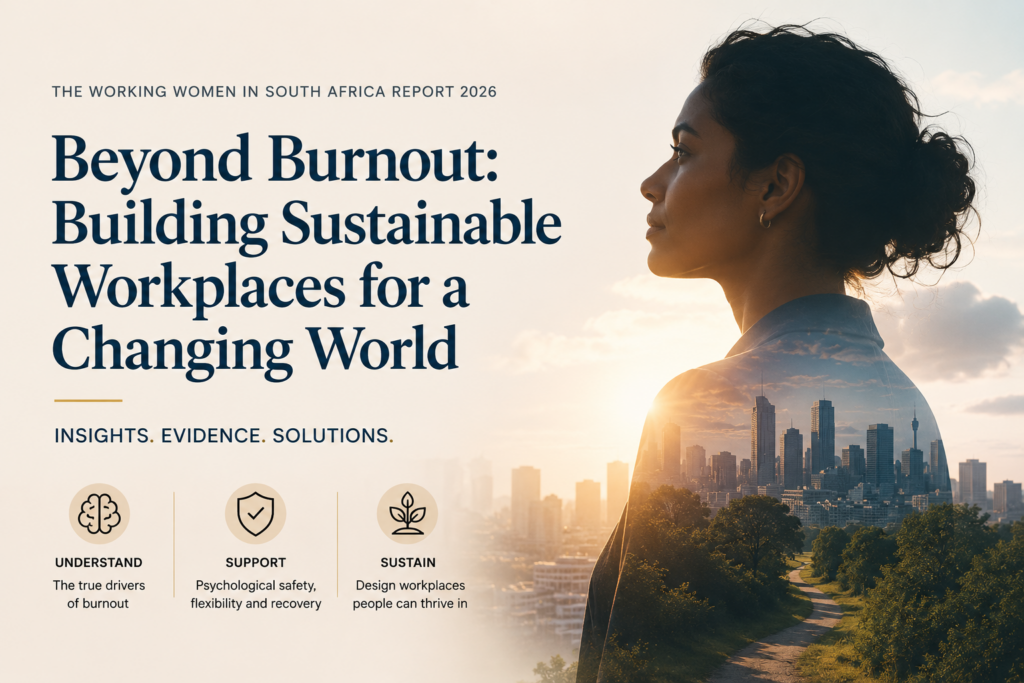
The Working Women in South Africa Report 2026 complied yearly by Recruit My Mom presents itself as a workforce trends report examining burnout, AI adaptation, return-to-office mandates, and employee wellbeing. Yet beneath the surface, the findings point toward something much larger: a structural regulation crisis emerging within the modern workplace.
The data does not describe a workforce lacking ambition, resilience, or work ethic. On the contrary, it describes a highly educated, highly responsible, financially committed workforce attempting to sustain functioning under increasingly cumulative cognitive, emotional, and practical load.
This distinction matters.
Burnout is still commonly framed as an individual wellness issue. The language surrounding it often focuses on self-care, resilience, coping skills, or emotional fragility. However, the findings of this report strongly suggest that burnout is increasingly better understood as a systems-level regulation problem: a mismatch between human cognitive capacity and the sustained demands being placed upon it.
This is where the RESTORE™ Framework becomes relevant.
RESTORE™ is not a therapeutic model. It is a structured regulation framework concerned with sustainable cognitive and nervous system functioning in environments of prolonged demand. Rather than focusing on pathology, RESTORE™ examines how cumulative load, attentional depletion, reduced recovery, and chronic activation affect long-term functioning, performance, and wellbeing.
Viewed through this lens, the report reveals several important realities about the future of work.
Burnout is not primarily an emotional problem
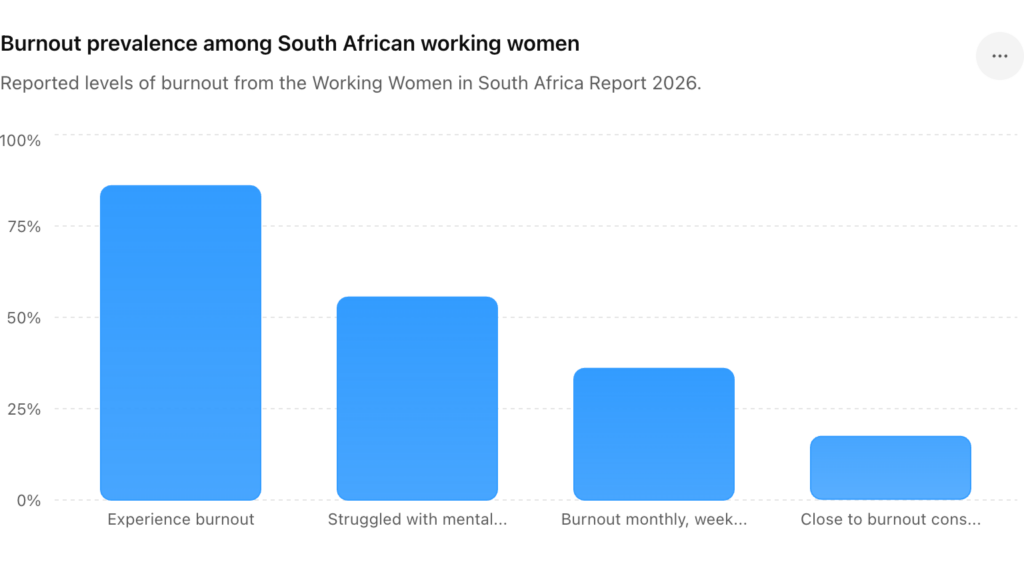
The most striking statistic in the report is not simply that burnout exists, but the scale at which it has normalised.
According to the findings:
- 86% of women experience burnout to some degree
- 36% experience burnout monthly, weekly, or constantly
- 17.4% report feeling close to burnout constantly
- 55.5% struggled with mental wellbeing in the past year
These are not marginal numbers. They indicate that overload is becoming embedded into normal workforce functioning.
Importantly, the report also identifies the primary contributors to stress:
- financial pressure
- workload volume
- balancing family and work responsibilities
This is a critical finding because it shifts burnout away from simplistic narratives around emotional weakness or poor coping. The data instead points toward cumulative load exposure.
The modern workplace increasingly demands:
- continuous executive functioning
- rapid task-switching
- sustained attentional control
- high responsiveness
- emotional regulation under pressure
- constant adaptability
- prolonged cognitive engagement with insufficient recovery
For many individuals, especially those already carrying caregiving, financial, or invisible emotional labour responsibilities, the issue is not lack of motivation. The issue is prolonged activation without sufficient restoration.
From a RESTORE™ perspective, burnout is often less accurately described as “stress” and more accurately described as cognitive and nervous system depletion.
Flexibility is not about convenience
One of the clearest patterns throughout the report is the overwhelming preference for hybrid and remote work arrangements.
91% of respondents preferred hybrid or fully remote work.
Yet a substantial proportion remain fully office-based, producing one of the largest preference-function mismatches in the report.
This is often interpreted within organisational discourse as a debate about convenience, lifestyle preference, or productivity. However, the data suggests something more significant.
For many individuals, workplace flexibility functions as a regulation support mechanism.
Office-based environments often increase:
- sensory load
- commute fatigue
- attentional interruption
- social vigilance
- cognitive switching demands
- unpredictability
- masking requirements
- recovery loss
This is especially relevant for neurodivergent individuals, high-masking professionals, caregivers, and those already operating near cognitive capacity.
The report itself indirectly supports this interpretation. Women whose office attendance increased frequently reported reduced job satisfaction and active consideration of leaving their roles.
At the same time, business owners demonstrated lower burnout rates and the smallest gap between preferred and actual work structure.
This is notable because autonomy itself is often regulatory.
When individuals have greater control over:
- environment
- scheduling
- pacing
- recovery
- transitions
- sensory conditions
- workload distribution
their nervous systems typically sustain functioning more effectively over time.
This reframes flexibility entirely.
Flexibility is not merely a perk. In many cases, it is infrastructure for sustainable functioning.
Invisible load is one of the central drivers of burnout
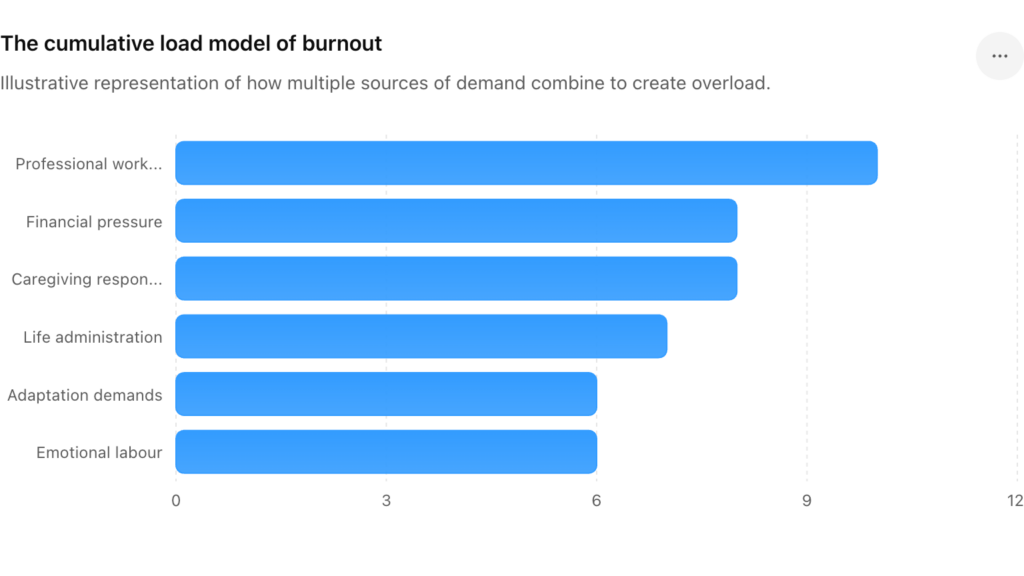
The report repeatedly highlights the enormous level of responsibility carried by respondents:
- 45% are sole income earners
- 80.4% support dependants
- women aged 35–44 show the highest burnout levels
These findings are important because they reveal that workplace functioning cannot be isolated from total life load.
Modern burnout discussions often underestimate invisible cognitive labour:
- planning
- anticipating
- remembering
- emotional tracking
- caregiving coordination
- household management
- schedule management
- social responsibility
- constant mental monitoring
Many individuals are functioning within dual full-time systems:
- professional workload
- invisible life administration
The nervous system does not separate these categories.
From a regulation perspective, cumulative load matters more than where the load originates.
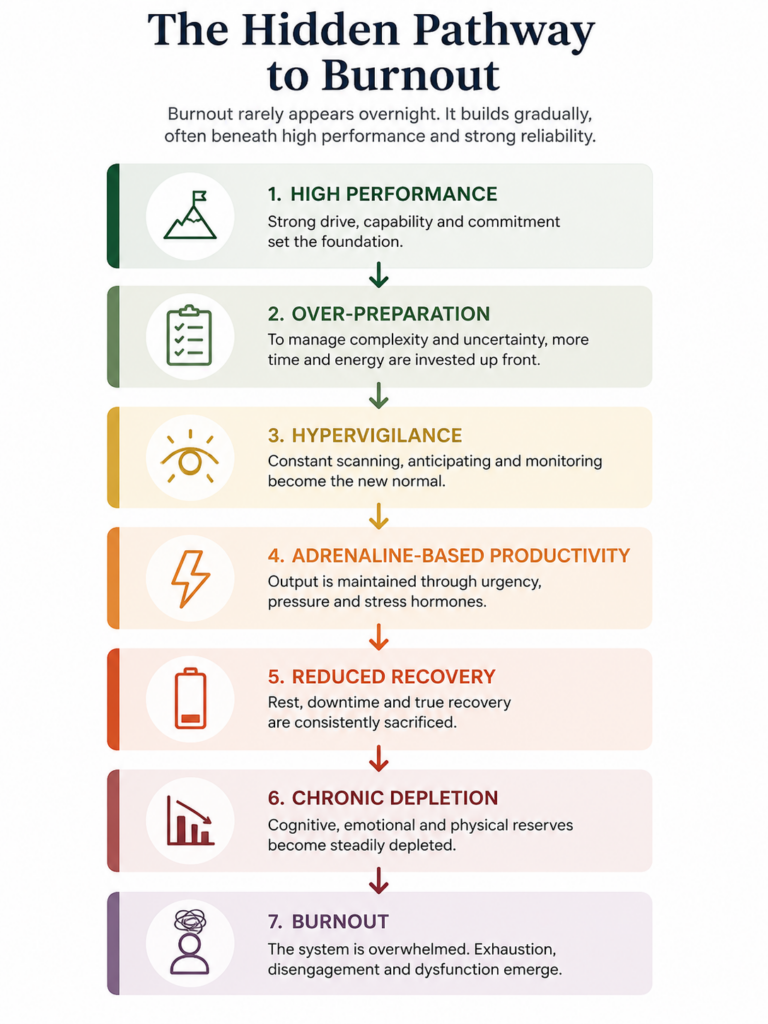
This becomes particularly relevant in neurodivergent populations, where executive functioning may already require greater energy expenditure. High-performing ADHD and autistic women frequently compensate through:
- hypervigilance
- perfectionism
- over-preparation
- masking
- sustained adrenaline-driven productivity
These strategies may preserve outward performance temporarily while simultaneously accelerating internal depletion.
The result is often delayed collapse rather than visible dysfunction.
The workplace has a restoration problem
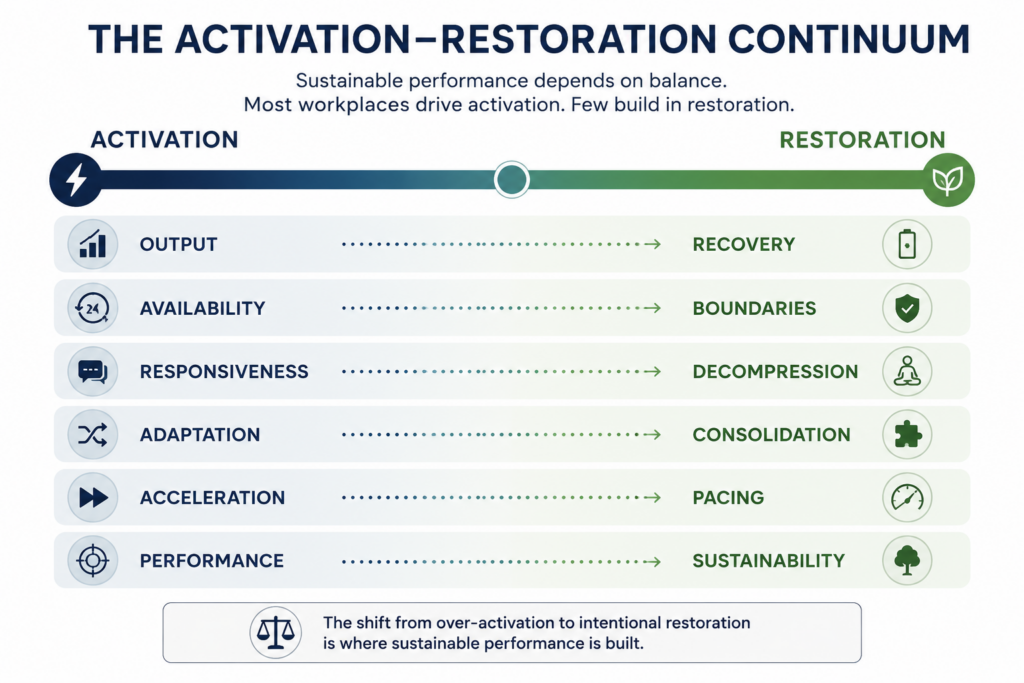
One of the most important implications of the report is that modern workplaces remain heavily structured around activation while investing comparatively little in restoration architecture.
Most organisational systems optimise for:
- output
- responsiveness
- availability
- adaptability
- efficiency
- productivity
- acceleration
Far fewer optimise for:
- attentional sustainability
- cognitive recovery
- restoration
- pacing
- reduced fragmentation
- predictable recovery opportunities
- nervous system regulation
| Traditional Workplace Priorities | Sustainable Workplace Priorities |
| Productivity | Recovery |
| Responsiveness | Decompression |
| Availability | Boundaries |
| Adaptability | Predictability |
| Acceleration | Pacing |
| Output | Sustainability |
Figure 1: Most workplaces are designed around activation. Sustainable workplaces require restoration architecture.
This imbalance matters because human cognitive systems are not designed for continuous high-output functioning without restoration.
The RESTORE™ Framework proposes that sustainable performance depends not merely on productivity capacity, but on restoration capacity.
Without restoration:
- executive functioning deteriorates
- attentional regulation weakens
- emotional regulation declines
- cognitive flexibility reduces
- decision fatigue increases
- shutdown risk rises
- burnout accelerates
Importantly, restoration is not equivalent to passive rest.
Scrolling, passive media consumption, or collapsing into inactivity after overload often do not adequately restore cognitive systems already under chronic strain.
Sustainable restoration frequently requires:
- reduced cognitive demand
- reduced decision load
- sensory regulation
- structured decompression
- predictable recovery rhythms
- attentional downshifting
- nervous system safety
- lower-performance states without guilt or threat
This is fundamentally different from simplistic “wellness” messaging.
Psychological safety is also a regulation issue
The report found that 44.1% of women do not feel safe discussing mental health at work.
This has broader implications than organisational culture alone.
Environments perceived as psychologically unsafe often maintain chronic low-level threat activation. When individuals feel they must:
- mask distress
- conceal overload
- suppress struggle
- maintain high-functioning appearances
- avoid vulnerability
the nervous system remains in prolonged states of vigilance.
Over time, this increases cumulative strain.
Psychological safety therefore affects not only morale, but cognitive sustainability itself.
This becomes especially relevant in workplaces where employees feel unable to:
- disclose overload
- request flexibility
- discuss attentional difficulties
- acknowledge burnout
- reduce demand temporarily
Without psychological safety, restoration becomes harder to access.
Ai is increasing adaptation demand
The report’s AI findings are particularly important because they challenge common assumptions.
Most respondents were optimistic about AI and viewed it positively.
However, fewer than half felt adequately supported in adapting to it.
This points toward another emerging issue: continuous adaptation strain.
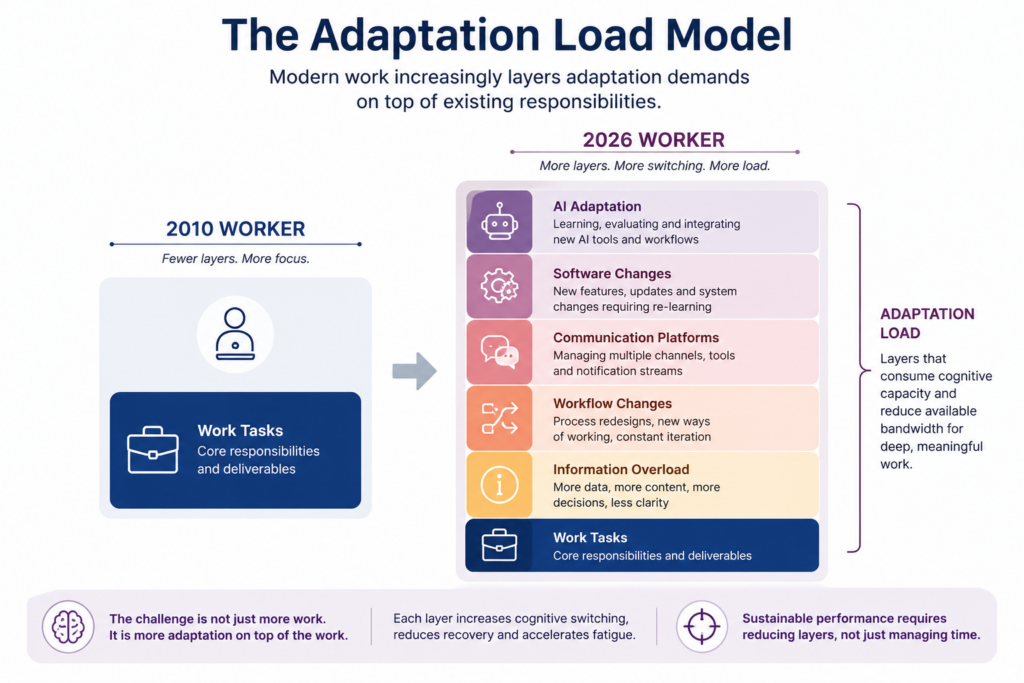
Modern workers are already adapting constantly to:
- software changes
- communication demands
- fragmented workflows
- accelerated information flow
- increasing responsiveness expectations
AI now introduces:
- continual upskilling pressure
- uncertainty
- cognitive adaptation demands
- competence anxiety
- workflow restructuring
Again, the issue is not necessarily the technology itself.
The issue is adaptation without sufficient restoration.
Human cognitive systems require consolidation periods in order to adapt sustainably. When adaptation pressure becomes continuous, exhaustion often follows.
The future of work requires sustainable cognitive design
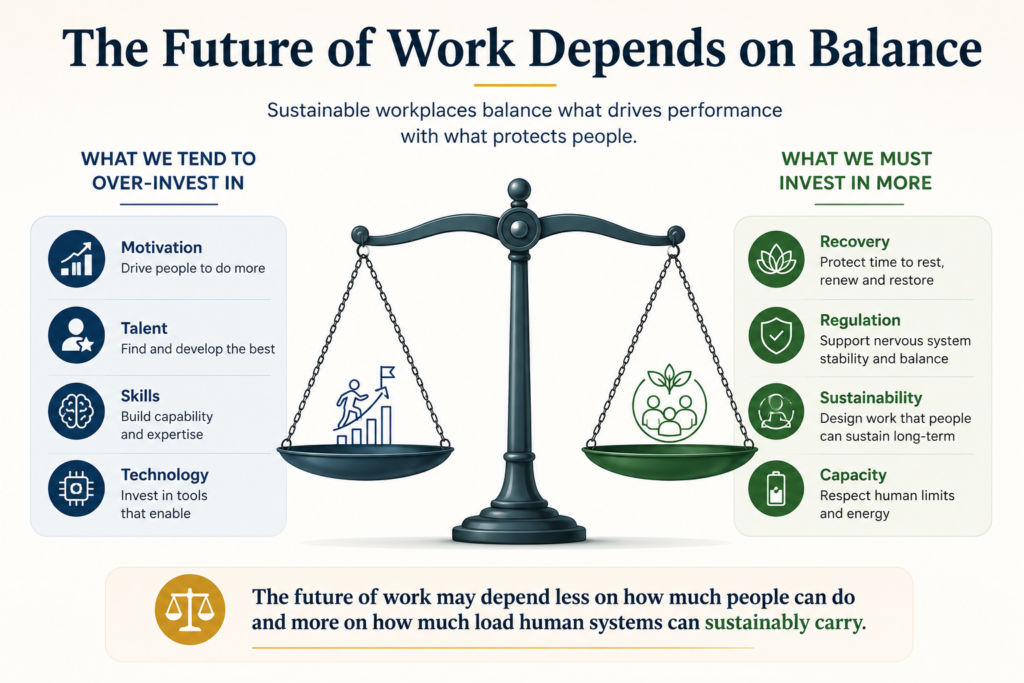
Perhaps the most important insight from this report is that many current workplace systems are approaching the limits of human sustainability.
The solution is unlikely to come from isolated wellbeing initiatives alone.
What is increasingly needed is structural redesign around sustainable functioning:
- reduced overload accumulation
- greater autonomy
- better recovery architecture
- realistic workload expectations
- cognitively sustainable workflows
- flexibility
- regulation-informed leadership
- psychologically safer environments
- reduced attentional fragmentation
The future workforce challenge may not primarily be motivation, talent, or even AI adaptation.
It may be whether organisations can create environments that human nervous systems can sustainably function within over time. The Working Women in South Africa Report 2026 provides important evidence that this issue is no longer theoretical. It is already measurable at scale.
