
Before Motivation (It Was Never Accountability)

Don’t want to read? Listen to it here:
Part 1: A Curious Pattern
Over the years, I heard the same request so often that it began to sound almost like a mantra.
“I think I just need someone to keep me accountable.”
I accepted the request because accountability was the solution everyone seemed to recommend. Coaches, managers, teachers and therapists all used it. It was treated almost as common sense. Yet, if I am honest, it never completely resonated with me. I couldn’t explain why, but something about it felt incomplete.
What surprised me most was who was asking.
These were not people who lacked ambition or who didn’t care. If anything, they cared too much. They wanted to succeed, they wanted to change and they were often painfully aware of what they weren’t getting done.
Their harshest accountability partner was usually their own inner critic.
Long before they spoke to me, they had already reminded themselves of what they should be doing. They had already criticised themselves for not starting, not finishing or not doing enough. Adding my voice to theirs rarely seemed to change very much. Sometimes it simply gave them one more reason to feel they had failed.
That observation stayed with me.
If accountability was the answer, why were so many people who already held themselves relentlessly accountable still struggling?
The more I sat with that question, the less interested I became in finding better accountability strategies and the more interested I became in understanding the gap itself.
Why can someone genuinely want to do something, know exactly what they want to achieve and still find themselves unable to begin? They had, after all, read the books, watched the videos, downloaded the apps and collected more advice than they could possibly use. Yet the gap between knowing and doing remained.
That question became the starting point for everything that follows.
Part 2: Knowing Is Not Doing
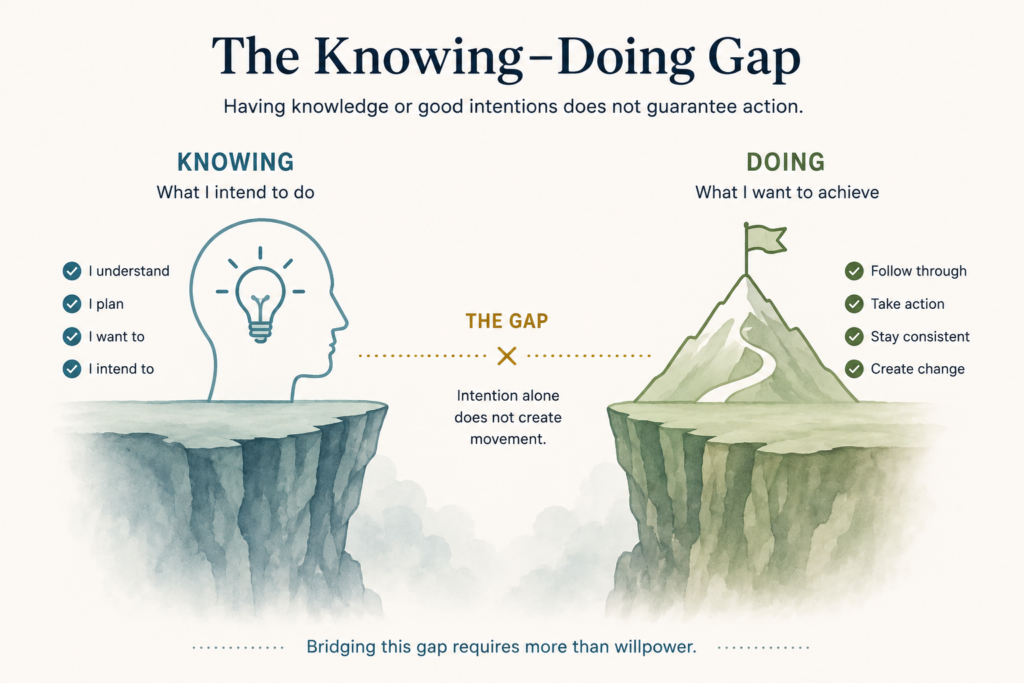
As I explored this question, I realised there was another assumption I had rarely challenged.
We often assume that if people know what to do, they will eventually do it. Advice, education and information are built on this belief. We explain, teach and encourage, expecting that knowledge will naturally shift into action.
Yet my clients repeatedly demonstrated that this wasn’t always true.
Many knew exactly how to improve productivity. They knew how to gamify tasks, build sophisticated planning systems and organise their work. Some could create systems that other people would have benefited from using.
Knowledge was not the missing ingredient.
This distinction has been recognised by researchers for many years. Russell Barkley, one of the leading experts on ADHD, famously observed that ADHD is not primarily a disorder of knowing what to do, but of doing what one knows. Although Russell Barkley was describing ADHD, I began to wonder whether the distinction between knowing and doing might help explain behaviour more broadly.
The people sitting opposite me did not necessarily have ADHD. They did, however, share the same frustrating experience: the gap between knowing what they wanted to do and consistently being able to do it.
If knowledge alone were enough, advice would be remarkably effective. Yet most of us already know many of the things that would improve our lives.
Clearly, something else influences whether our inner knowledge shifts into outer behaviour.
This shifted my attention away from trying to understand what people knew and towards a different question.
What allows our inner knowledge to shift into outer behaviour?
To answer that, we first need to reconsider what behaviour actually is.
Part 3: Behaviour Is More Than a Decision
The question of how our inner knowledge shifts into outer behaviour assumes something that is rarely questioned: that behaviour is simply a decision.
We tend to think that once a person has decided to act, the behaviour should naturally follow. If it doesn’t, we often conclude that motivation has faded or discipline has failed.
But not everything in life can be commanded into existence.
We cannot simply decide to fall asleep. Creativity rarely appears on demand. The harder we try to force some processes, the more resistant they often become.
A farmer understands this instinctively.
No farmer stands in a field demanding that a seed grows. Growth cannot be forced. Instead, the farmer prepares the conditions. The soil is cultivated, the seed is planted, water is provided and the environment is protected.
Growth is not something the farmer produces. It is something that emerges when the conditions are right.
Growth is not something the farmer produces. It is something that emerges when the conditions are right.
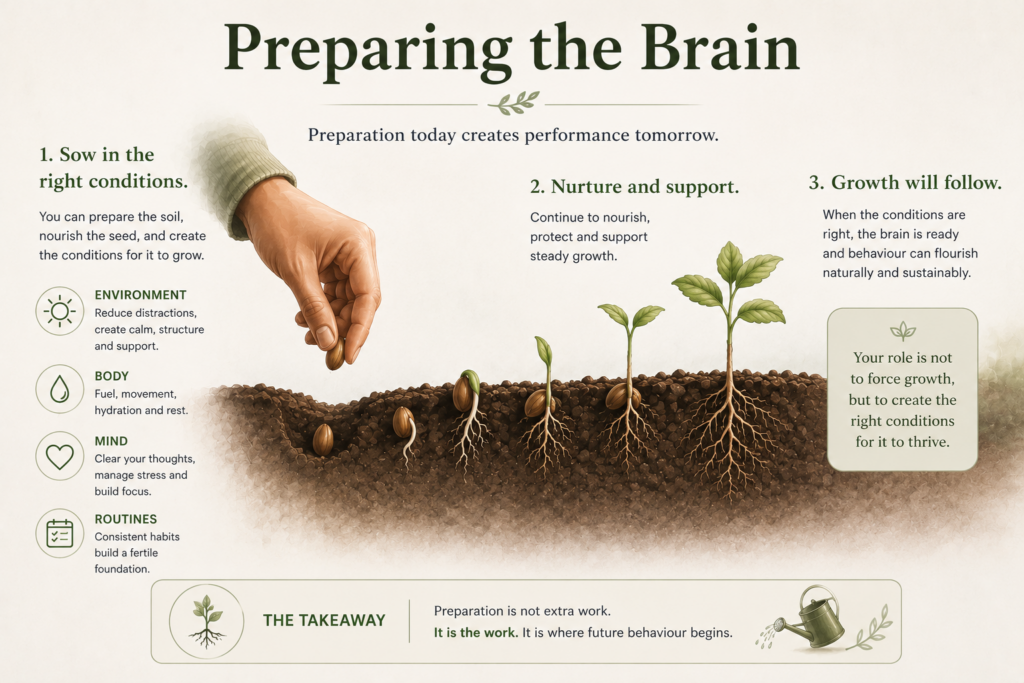
Perhaps behaviour works in much the same way.
Behaviour is not simply something we choose. It is something that emerges when intention meets the right conditions.
Behaviour is not simply something we choose. It is something that emerges when intention meets the right conditions.
This perspective helps explain why the same person can appear highly motivated in one situation and completely stuck in another, despite having the same goals, abilities and values. The difference may not lie entirely within the individual, but within the conditions under which they are trying to act.
Decisions matter. But they are only one part of the system. The state of the brain, the body and the world around us also influence whether an intention shifts into behaviour.
Once we begin to see behaviour as an emergent property rather than a simple act of will, the question changes.
Instead of asking how to force better behaviour, we begin asking what conditions allow behaviour to emerge in the first place.
That question leads naturally to another.
If behaviour depends on conditions, should we be spending less time trying to prepare the task and more time preparing the brain that has to perform it?
Part 4: Preparing the Brain
If behaviour emerges from a system rather than from willpower alone, then trying harder is only part of the solution.
We have all seen a coach standing beside an athlete who is about to perform. We see the coach ask, “Are you ready?”
Before the performance begins, the athlete pauses for a brief mental and physical scan. If they are ready, they nod, and only then do they perform. The performance is not triggered by the cue alone, but by a system that has already been prepared.

Yet we often begin tasks without first asking whether we, as a whole, including our brain, are ready for them.
Instead, we often expect our brain to produce the same level of performance regardless of the state it is in. We become frustrated when concentration disappears, when simple decisions feel overwhelming or when manageable tasks suddenly feel impossible. We often treat these experiences as failures of character rather than recognising them as the predictable consequences of an unprepared system.
This is not to suggest that behaviour is beyond our control. Rather, it suggests that control begins earlier than we often assume.
Before asking the brain to focus, solve problems, make decisions or regulate emotions, we should first consider the state it is in.
This simple shift has important implications. Instead of directing all our effort towards the task itself, we begin paying attention to the conditions under which the task is being attempted. The question is no longer, “How can I make myself do this?“ but, “What does my brain need in order to do this well?”
This is not about lowering expectations or making excuses. It is about recognising that performance depends on more than ability alone. We would never expect an athlete to perform at their best without first considering their readiness. Yet we routinely expect exactly that from our brains.
Because the brain does not function in isolation. It is continually responding to the body it inhabits and the environment in which it operates. The state of the brain is therefore constantly changing.
We spend a great deal of time preparing the task.
Perhaps we should spend just as much time preparing the brain that is expected to carry it out.
Part 5: The Brain and Its Environment
We often think of the brain as though it operates independently of the world around it. We imagine that our thoughts, decisions and behaviour originate entirely within us, while our surroundings merely provide the backdrop. The brain is in constant conversation with its environment.
The brain is in constant conversation with its environment.
That environment is not only the world around us. It also includes the body in which the brain resides. In other words, the brain is continually responding to both its external environment and its internal environment. The external environment includes the people around us, the physical spaces we occupy and the countless sensory experiences we encounter throughout the day. The internal environment includes the ever-changing state of our physical, emotional and physiological state.
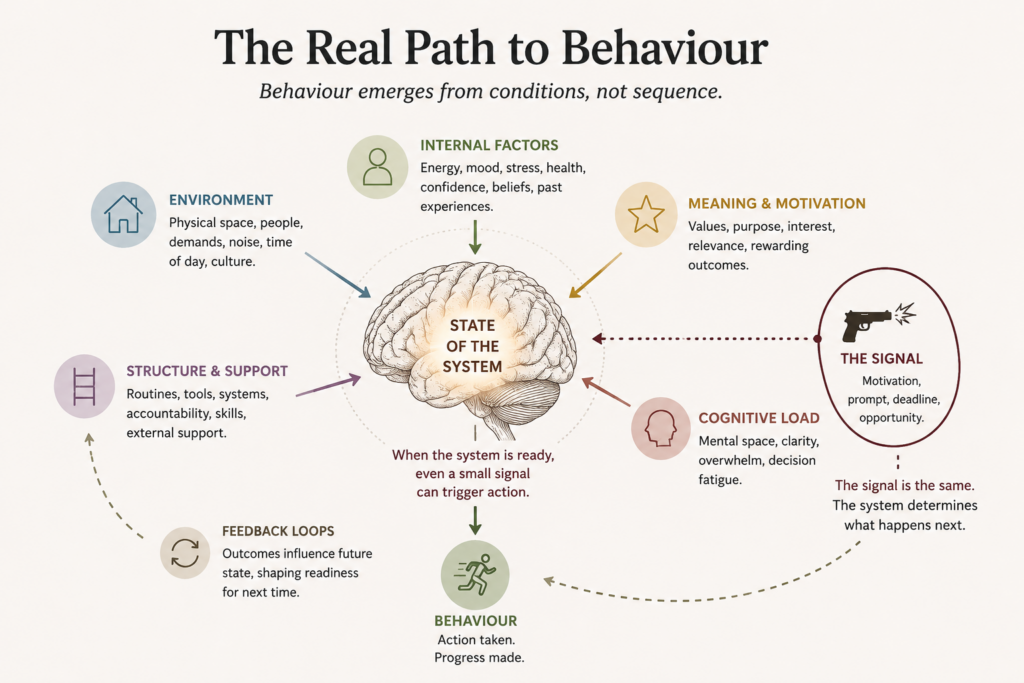
Every moment, the brain is receiving, filtering and integrating information from both of these environments, continually updating its understanding of what is happening within us and around us. These influences are not distractions from behaviour. They help shape it.
This helps explain why the very same task can feel effortless one day and overwhelming the next. The task itself may not have changed, but the system attempting it has.
Rather than asking why we cannot always perform consistently, perhaps we should be asking why we expect to.
This also changes the way we think about our environment. It is not simply the setting in which behaviour takes place. It is an active part of the system from which behaviour emerges. The brain is continuously responding to changes both within us and around us, adapting its priorities and allocating its resources accordingly.
Modern neuroscience increasingly supports this perspective. Karl Friston’s Free Energy Principle proposes that the brain is continuously integrating information from both the internal and external environment in order to guide perception and behaviour. Rather than viewing the brain as an isolated decision-making organ, this framework describes it as part of a dynamic system that is constantly adapting to changing conditions.
Rather than viewing the brain as an isolated decision-making organ, this framework describes it as part of a dynamic system that is constantly adapting to changing conditions.
If behaviour emerges from this interaction, then changing behaviour is not always about changing the individual. Sometimes it requires changing the conditions in which the individual is trying to function.
That naturally leads to another question.
If we can influence the environments in which the brain operates, can we also intentionally influence the state of the brain before asking it to perform?
Part 6: Changing the State
If the brain’s state influences behaviour, then an important possibility emerges. Perhaps we do not always need to change the task itself. Sometimes the more effective intervention is to change the brain’s state before attempting the task.
In essence, we need to change the brain’s operating system—or, more accurately, the state in which it is operating. The brain is then responding to a different internal and external environment and, in doing so, enters a different state.
If we can intentionally change the brain’s state before asking it to perform, then the question becomes how. What influences the brain’s operating state in ways that help us engage with difficult tasks? The more I thought about it, the more I realised I had been thinking about motivation the wrong way.
Instead of seeing motivation as something we either had or didn’t have, I began to see it as something we could create, use as a tool and aim towards the task itself.
Instead of seeing motivation as something we either had or didn’t have, I began to see it as something we could create, use as a tool and aim towards the task itself.
We assume that if we dislike a task, we must somehow find motivation within the task itself. Think about doing your taxes, tackling your accounting or working through paperwork that has been sitting untouched for weeks. We stare at the task, hoping it will somehow become motivating. We tell ourselves to just get on with it, remind ourselves why it needs to be done and try to talk ourselves into wanting to do it. But perhaps we are looking in the wrong place. An unpleasant task rarely becomes motivating, even though we continue to look for motivation within it. Instead, we may be able to generate motivation elsewhere and then direct that motivation towards the task itself.
When I was at university, we used to laugh about how spotless everyone’s rooms became just before exams. Students who had happily lived amongst piles of clothes, coffee mugs and clutter for weeks would suddenly vacuum, dust, organise their desks and make their beds before opening a single textbook. From the outside, it probably looked like procrastination.
Looking back, I think it was something else.
We were preparing ourselves.
The ritual changed both our external environment and our internal state before sitting down to study. We weren’t simply preparing the room. We were preparing the brain that was about to study.
These behaviours are easy to dismiss as procrastination or simply habit. Perhaps they serve a deeper purpose. Rather than changing the task itself, they may help change the state of the brain before we ask it to perform.
Rather than changing the task itself, they may help change the state of the brain before we ask it to perform.
We do this more often than we realise. Athletes develop pre-performance routines before competing. Musicians prepare before walking onto a stage. Children often create familiar routines before attempting something they find difficult. Although these rituals differ from person to person, they may serve the same purpose: changing the brain’s operating state before performance.

Modern neuroscience supports this perspective. Dopamine is now understood to play an important role in behavioural activation, effort and the willingness to initiate action, rather than simply being the brain’s “reward chemical” (Salamone & Correa, 2012; Westbrook & Braver, 2016). If our internal and external environments influence these systems, then changing our state before beginning a task may influence our readiness to engage with it.
Perhaps motivation is not something we simply find. Perhaps it is something we can create, use as a tool and deliberately aim.
Perhaps motivation is not something we simply find. Perhaps it is something we can create, use as a tool and deliberately aim.
Part 7: Rethinking Motivation
If changing our state can make action more likely, then perhaps it is time to redefine how we understand motivation.
We often speak about motivation as though it is something we either have or lack. It is treated as the starting point for behaviour—a feeling that appears first and then drives us to act. When it is absent, we wait for it to return.
Perhaps we have been looking at motivation the wrong way.
No more is motivation a feeling that simply drops into our laps. Someone once said, “If you want opportunities to drop into your lap, have your lap where opportunities drop.” Perhaps we should think about motivation in much the same way. If we want motivation to activate the brain’s systems, we must first place ourselves in the conditions where motivation is created.
We often think motivation is the walk to the starting line. Perhaps it isn’t. Perhaps motivation is the starting gun.
Without preparation, the gun changes very little. But when the system is ready, the very same signal triggers action. Preparation changes the state of the brain, creating the conditions in which motivation is no longer the starting point, but the activation that ultimately leads to behaviour.
Preparation comes first. The brain enters a different state. Motivation becomes the activation. Behaviour follows.

This way of thinking moves motivation from being something we passively wait for to something that develops under the right conditions. It is no longer simply a feeling that appears before action, but part of a dynamic system that prepares the brain to engage.
If behaviour emerges from a well-prepared system, then motivation may also emerge from the same conditions. This suggests that motivation is not always the cause of behaviour. Sometimes it is the consequence of creating the conditions from which behaviour emerges.
Rather than asking, “How do I become more motivated?”, we might ask, “What conditions make motivation more likely to appear?”
This shift is subtle but important.
It moves the focus away from trying to generate a feeling and towards creating an environment and physiological state that support action. Motivation becomes less mysterious and less dependent on chance. It is no longer something we passively wait for, but something that often develops as we engage with the right conditions.
It (motivation) is no longer something we passively wait for, but something that often develops as we engage with the right conditions.
This also explains why advice to “just be more motivated” is so rarely helpful. It treats motivation as an isolated trait rather than the product of a dynamic system.
If motivation is not the beginning of the story, then accountability may not be either.
Perhaps both are better understood as influences on the brain’s operating state rather than the primary drivers of behaviour themselves.
Part 8: Accountability Revisited
By this point, my view of accountability had changed considerably.
I no longer saw accountability as the missing ingredient that enables behaviour by creating motivation. Instead, I began to see it as one of many influences that shape the conditions from which motivation and behaviour emerge.
This explains why accountability sometimes works remarkably well, yet at other times produces only temporary change—or very little change at all.
An accountability partner may provide structure, reduce uncertainty, create predictable routines or simply make a task feel less overwhelming. In doing so, they influence the conditions in which behaviour takes place and may temporarily change our operating state. Behaviour becomes easier—not necessarily because the person has become more disciplined, but because the system has become more supportive.
Sometimes, however, accountability alone is not enough. If the underlying conditions remain unchanged, the benefits often disappear once the external support is removed. In much the same way, a cup of coffee may make us feel more alert even though we are still tired. Accountability can change our operating state without necessarily changing the system itself.
It means accountability was never designed to do the whole job.
…accountability was never designed to do the whole job.
Rather than asking whether people need accountability, perhaps we should ask a different question.
What is accountability changing?
The answer is rarely motivation alone. More often, it is changing the conditions under which behaviour occurs.
This perspective transforms accountability from a solution into a tool—one that can be highly effective when it supports the right conditions, but far less effective when it is expected to overcome an unprepared system on its own. That is rather like trying to build a house with beach sand instead of bricks. The structure may hold for a while, but the foundation was never suitable to begin with.
If accountability is only one influence on the system, then our ultimate goal cannot be dependence on someone else. It must be learning how to create the conditions that allow motivation and behaviour to emerge for ourselves.
That is where agency begins.
Part 9: Agency
If accountability is a tool rather than the destination, then what are we really trying to achieve?
I believe the answer is agency.
Agency is often mistaken for complete independence, but they are not the same thing. Human beings have always relied on relationships, communities and supportive environments. Needing help does not mean we lack agency.
Agency is the ability to understand the conditions from which our behaviour emerges and to intentionally shape those conditions over time.
Agency is the ability to understand the conditions from which our behaviour emerges and to intentionally shape those conditions over time.
It is learning to work with our brain rather than expecting it to perform regardless of its operating state.
This is a different kind of responsibility.
Instead of repeatedly asking ourselves to try harder, we begin asking how we can better prepare the system from which our behaviour emerges. We become curious about our patterns rather than frustrated by them. We stop viewing every difficult day as a personal failure and start recognising that the quality of our decisions is often influenced by factors we can observe, understand and, to some extent, modify.
Agency is not about controlling everything.
Many circumstances remain beyond our influence. Illness, stress, loss and unexpected events will always affect how we function. But even within those constraints, we can often shape enough of our internal and external environments to make successful action more likely.
Perhaps that is the real value of understanding how behaviour emerges.
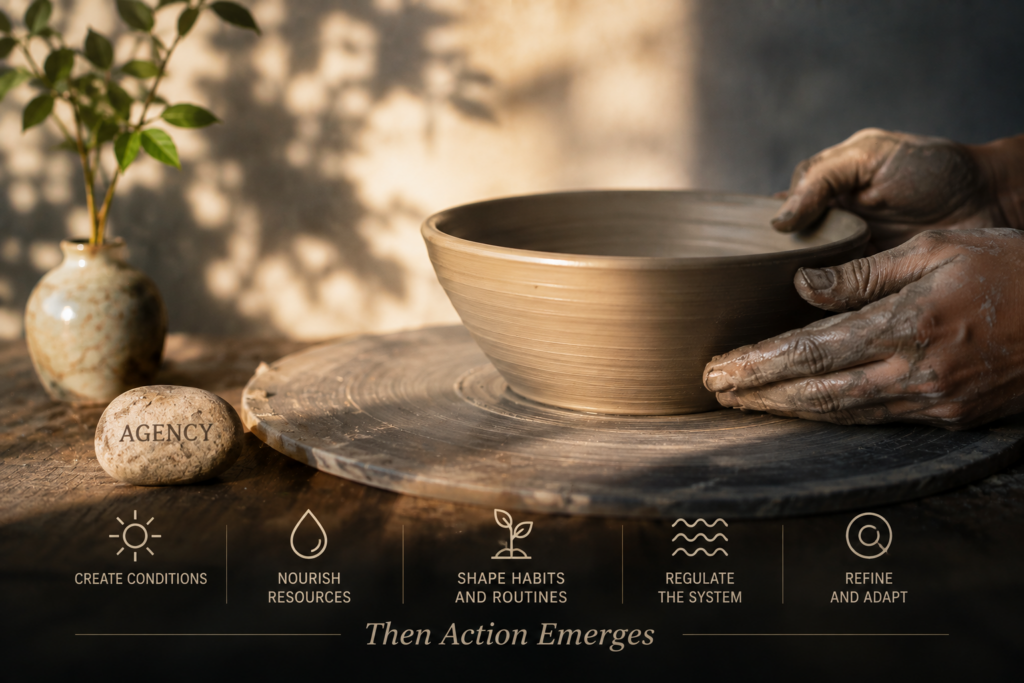
It replaces the impossible goal of perfect self-control with the more achievable goal of building conditions in which our intentions have a better chance of becoming actions.
And when those actions begin to accumulate, something important starts to grow alongside them.
Hope.
Part 10: Hope
One of the most rewarding moments in my work is not when someone completes a difficult task. It is when they realise they can.
For many people, years of struggling to act despite good intentions gradually erode something deeper than confidence. They begin to question their character. They describe themselves as lazy, undisciplined or incapable. Every unfinished task becomes further evidence that something is fundamentally wrong with them.
Often, they reject themselves on principle before they believe others will. Or they stop trying because failure feels inevitable.
A different explanation can change that.
When people understand that behaviour emerges from the interaction between their inner and outer states, they often stop seeing every struggle as a personal failure. Instead, they become curious. They begin experimenting with routines, environments and ways of preparing themselves before demanding more of themselves.
Small successes follow, and even modest progress begins to chip away at self-doubt. These experiences matter because they become evidence—not that life is easy or that change is guaranteed, but that change is possible. From that evidence, hope begins to grow.
From that evidence, hope begins to grow.
Hope is often described as the starting point for change, but I have come to see it differently. More often, hope is the result of repeated experiences in which intention successfully becomes action. It grows as small successes accumulate. Each success strengthens the belief that change is possible. Not because people suddenly discover greater willpower, but because they have learned to work with the system from which behaviour emerges.
Perhaps that is the most important outcome of all.
Understanding behaviour does more than help us act.
It helps us believe that we can.
Part 11: What This Means in Practice
If this perspective is correct, then it changes more than the way we think about behaviour. It changes the questions we ask when behaviour becomes difficult.
Instead of asking, “Why can’t I make myself do this?” we might ask, “What conditions are making this difficult?”
Instead of searching immediately for more discipline, we might first consider our inner and outer states.
Instead of hoping that another accountability strategy will solve the problem, we might begin by preparing ourselves before preparing the task.
Instead of trying harder to find motivation, we might ask whether motivation needs to be generated elsewhere, borrowed, or whether the conditions simply need to change.
These questions do not remove personal responsibility.
Rather, they encourage us to work with the brain instead of continually expecting it to overcome unfavourable conditions through willpower alone.
This perspective has also changed the way I work with clients.
Rather than focusing solely on goals or accountability, I spend more time helping people understand the patterns behind their behaviour. Together, we identify the conditions that consistently support action and those that consistently make action more difficult. We then develop practical ways of adapting their inner and outer worlds so that successful behaviour becomes more likely.
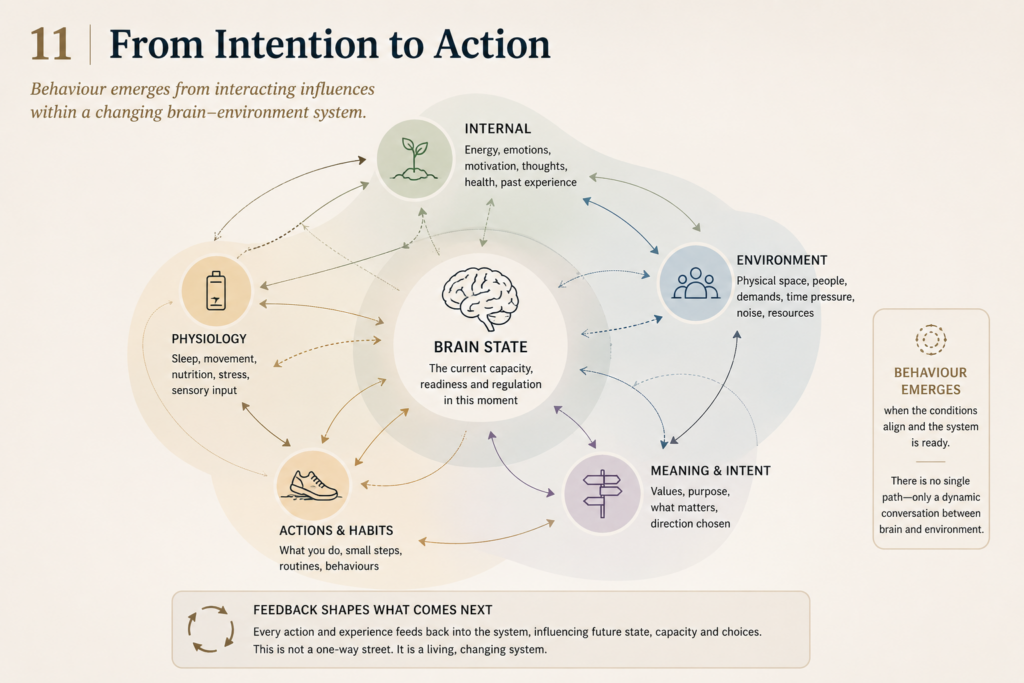
Small adjustments often prove more valuable than increasingly ambitious plans. They are also more sustainable because they fit the person rather than expecting the person to fit the strategy. Two people can have exactly the same goal and require entirely different conditions to achieve it.
Perhaps the greatest practical implication is this: behaviour becomes something to investigate rather than judge.
When action is difficult, the question is no longer, “What is wrong with me?”
It becomes, “What is my behaviour telling me about the system that produced it?”
Behaviour becomes information rather than moral judgement, and information is something we can learn from.
Behaviour becomes information rather than moral judgement, and information is something we can learn from.
Part 12: Conclusion
This essay began with a simple observation.
Why were so many capable, intelligent and genuinely motivated people asking for accountability when accountability so often failed to solve the problem?
Following that question led me to reconsider several assumptions that are commonly made about human behaviour. We often assume that knowing leads to doing, that motivation precedes action and that behaviour is largely a matter of willpower. Yet neither research nor everyday experience consistently supports these beliefs.
Instead, drawing together findings from neuroscience, psychology and behavioural science, I have argued that behaviour is better understood as an emergent property of a dynamic system (Barrett, 2017; Friston, 2010; Salamone & Correa, 2012; Westbrook & Braver, 2016). The brain, the body and the environment interact continuously, shaping whether an intention becomes action. Motivation, accountability and discipline still matter, but they are more accurately viewed as influences on that system than as independent causes of behaviour.
This perspective does not remove the effort involved in changing behaviour. It changes where that effort is invested. Rather than repeatedly expending energy trying to force action, we invest it in shaping the conditions from which action emerges. The effort is no longer wasted fighting the same obstacles, and the changes that follow are more likely to be sustained because the system itself has changed.
Rather than repeatedly expending energy trying to force action, we invest it in shaping the conditions from which action emerges.
Rather than asking people to simply try harder, we can help them understand the conditions under which they function best. Rather than judging behaviour as a reflection of character, we can view it as information about the system that produced it. Rather than waiting for motivation to appear, we can intentionally shape the conditions from which behaviour is most likely to emerge.
Throughout this essay, I have used the word motivation in more than one way. That is intentional. Motivation may be intentionally generated in one context and directed towards another task. It may be borrowed from another person or from external structures such as accountability, routines or deadlines. Or it may emerge more naturally as we learn to shape the conditions from which behaviour arises. Although these processes differ, they all influence the same behavioural system.
I do not believe this is the final explanation of human behaviour. It is simply a different way of thinking about a question that has troubled many of the people I have worked with over the years.
Sometimes the most important breakthrough is not discovering a new answer.
It is asking a better question.
Perhaps, instead of asking how we can become more motivated, disciplined or accountable, we should ask:
What conditions allow human beings to reliably act on their intentions?
Perhaps the question has never been why people fail to act.
Perhaps it has always been why we continue to think of action as a singular decision rather than recognising that behaviour emerges from a dynamic system.
Rather than viewing the brain as an isolated decision-making organ, it is better understood as part of a dynamic system that is constantly adapting to changing conditions.
If we misunderstand the nature of behaviour, we will continue searching for solutions in the wrong places. But if behaviour emerges from conditions, our task is no longer simply to motivate people. It is to understand those conditions and to help people shape them in ways that allow their intentions to become action.
References (APA 7th)
Barkley, R. A. (1997). Behavioral inhibition, sustained attention, and executive functions: Constructing a unifying theory of ADHD. Psychological Bulletin, 121(1), 65–94.
Barrett, L. F. (2017). How Emotions Are Made: The Secret Life of the Brain. Houghton Mifflin Harcourt.
Friston, K. (2010). The free-energy principle: A unified brain theory? Nature Reviews Neuroscience, 11(2), 127–138.
Salamone, J. D., & Correa, M. (2012). The mysterious motivational functions of mesolimbic dopamine. Neuron, 76(3), 470–485.
Westbrook, A., & Braver, T. S. (2016). Dopamine does double duty in motivating cognitive effort. Neuron, 89(4), 695–710.
